

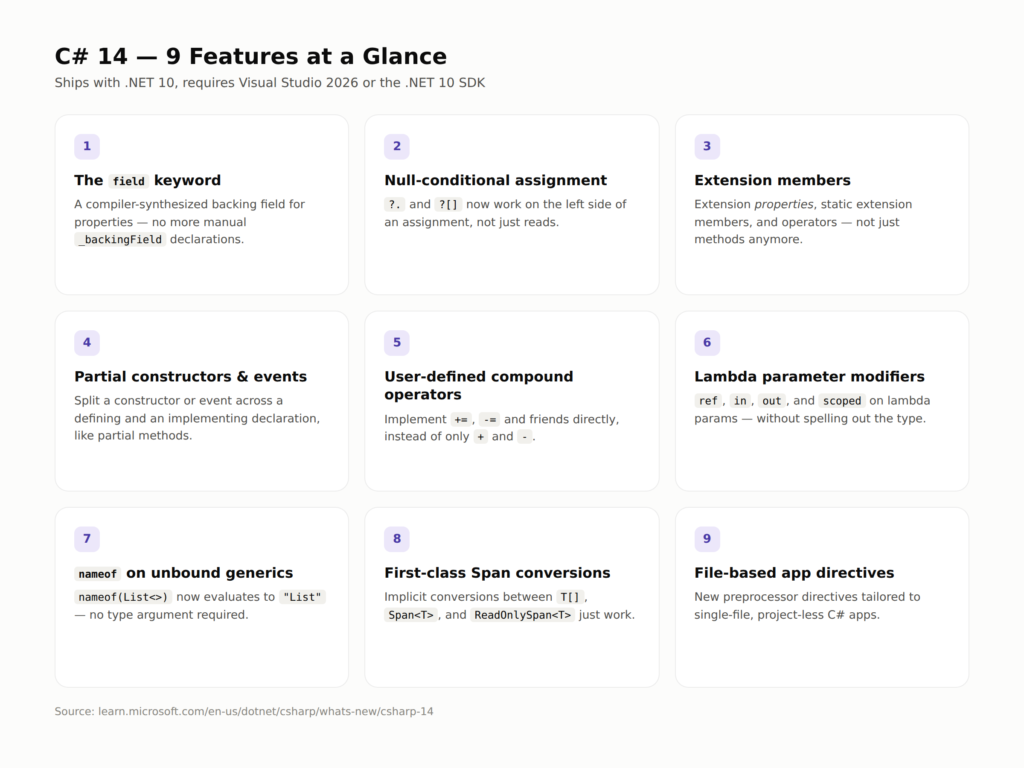
C# 14 ships alongside .NET 10 and requires either Visual Studio 2026 or the .NET 10 SDK. It’s not the kind of release that comes with a headline feature like records or pattern matching did — instead, it’s nine smaller additions that quietly remove boilerplate from code you write constantly. If you’ve been writing C# for a few years, several of these will immediately replace a pattern you’ve typed a hundred times.
Contents
- The field keyword: properties without the backing field dance
- Null-conditional assignment
- Extension members: beyond extension methods
- Partial constructors and partial events
- User-defined compound assignment operators
- Lambda parameters with modifiers, without the types
- nameof on unbound generic types
- First-class Span and ReadOnlySpan conversions
- Getting it
- Wrapping up
- Frequently asked questions
- Sources
The field Keyword: Properties Without the Backing Field Dance
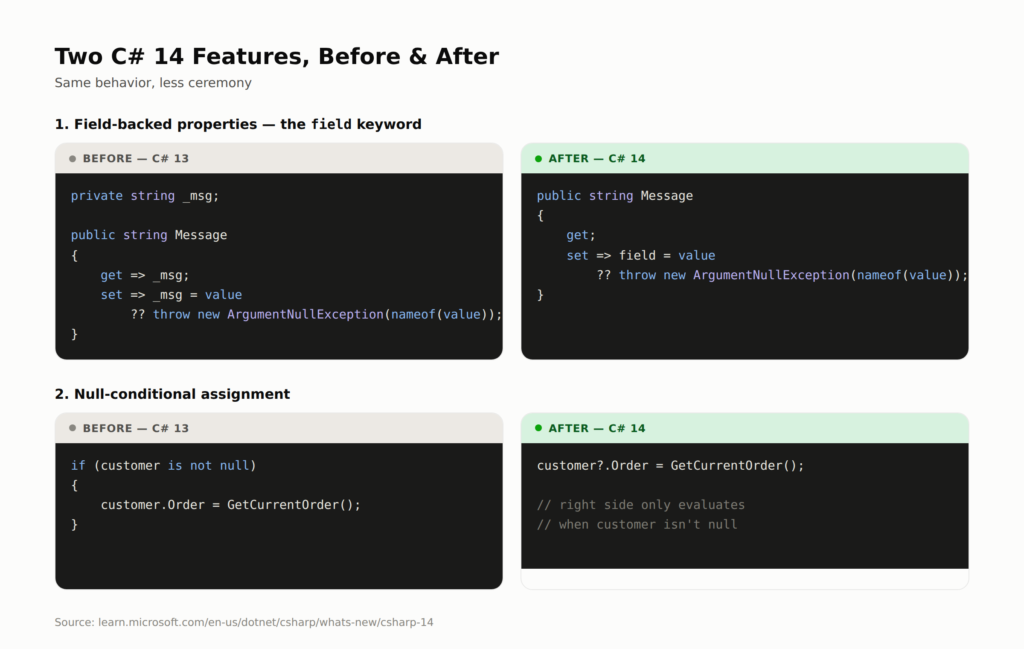
This is the feature most people will use on day one. Every C# developer has written this pattern dozens of times: declare a private backing field, then a property that wraps it with a bit of logic in the getter or setter.
// C# 13 and earlier
private string _msg;

public string Message
{
    get => _msg;
    set => _msg = value ?? throw new ArgumentNullException(nameof(value));
}
C# 14 gives the compiler a synthesized backing field you can reference directly with the contextual field keyword:
// C# 14
public string Message
{
    get;
    set => field = value ?? throw new ArgumentNullException(nameof(value));
}
You still get full control over validation, transformation, or side effects in the accessor — you just don’t need to name and declare the backing storage yourself. This works for any property that needs some logic but isn’t a fully auto-implemented property.
Null-Conditional Assignment
The ?. and ?[] null-conditional operators have worked on the right-hand side of an expression for years — reading a property only if the object isn’t null. C# 14 extends that same short-circuiting behavior to assignment.
// Before
if (customer is not null)
{
    customer.Order = GetCurrentOrder();
}

// C# 14
customer?.Order = GetCurrentOrder();
The right-hand side (GetCurrentOrder()) only evaluates if customer isn’t null, so you’re not paying for a wasted computation either. It’s a small change, but defensive null checks before an assignment are common enough that this cleans up real amounts of code in typical business logic.
Extension Members: Beyond Extension Methods
Extension methods have been part of C# since version 3.0, but they’ve always been limited to methods. C# 14 introduces extension blocks, which let you define extension properties and static extension members too:
public static class Enumerable
{
    extension<TSource>(IEnumerable<TSource> source)
    {
        public bool IsEmpty => !source.Any();
    }
}

// usage
if (myList.IsEmpty) { ... }
You can also declare static extension methods and even operators inside an extension block, which opens the door to extension-based fluent APIs that read more naturally than a chain of static method calls.
Partial Constructors and Partial Events
Partial methods have existed for a while, letting you split a declaration and its implementation — often across a hand-written file and a generated one. C# 14 extends that same idea to constructors and events, which matters more now that source generators are a common part of the .NET toolchain (EF Core, source-generated JSON, and others all lean on generators). A generator can now contribute part of a constructor’s logic without you writing the whole thing by hand.
User-Defined Compound Assignment Operators
Previously, if you overloaded + on a custom type, += was automatically derived from it — but you had no way to give += its own, more efficient implementation. C# 14 lets you define compound assignment operators directly:
public struct Vector
{
    public double X, Y;

    public static Vector operator +(Vector a, Vector b) => new(a.X + b.X, a.Y + b.Y);

    // now possible: a dedicated, in-place-mutating +=
    public void operator +=(Vector other)
    {
        X += other.X;
        Y += other.Y;
    }
}
This mostly matters for performance-sensitive value types where allocating a new instance on every += is wasteful — think vector math, big-number libraries, or anything in a hot loop.
Lambda Parameters with Modifiers, Without the Types
C# has allowed ref, in, out, and scoped parameter modifiers in lambdas for a while, but only if you also spelled out the parameter’s type. C# 14 lets you use those modifiers on inferred lambda parameters directly:
TryParse<int> parse = (text, out result) => Int32.TryParse(text, out result);Small, but it removes an annoying inconsistency where adding out to a lambda parameter used to force you to type out the full signature.
nameof on Unbound Generic Types
nameof(List<int>) has always worked. nameof(List<>) — referring to the generic type itself, with no type argument — didn’t compile before C# 14. Now it does, and it evaluates to "List". It’s a minor addition, but useful in logging, reflection-adjacent code, and generic diagnostics where you want to refer to a generic type by name without committing to a specific closed generic instantiation.
First-Class Span and ReadOnlySpan Conversions
Span<T> and ReadOnlySpan<T> have been part of the performance-oriented side of .NET since C# 7.2, but converting between arrays, Span<T>, and ReadOnlySpan<T> has always involved a bit of ceremony. C# 14 adds implicit conversions across all three, so APIs that accept spans are now much easier to call with plain arrays and vice versa — without extra .AsSpan() calls scattered through your code.
Getting It
C# 14 requires the .NET 10 SDK (or Visual Studio 2026). If you followed the previous article in this series and upgraded to .NET 10, you already have it — just bump your project’s language version if it isn’t picked up automatically, and start using these where they make sense. None of these features require you to rewrite existing code; they’re opt-in improvements for the code you write next.
Wrapping Up
None of C# 14’s additions are individually dramatic, and that’s kind of the point — this is a release focused on sanding down rough edges rather than introducing new paradigms. The field keyword and null-conditional assignment alone will show up in most of the C# you write from here on out, and the rest — extension properties, compound operators, partial constructors — are the kind of thing you’ll reach for exactly when you need them.
Frequently Asked Questions
Do I need .NET 10 to use C# 14?
Yes. C# 14 requires the .NET 10 SDK or Visual Studio 2026, which includes it.
Will C# 14 break my existing code?
No feature requires you to change existing code. The one thing to check is any class that already has a member literally named field, since the new contextual keyword takes precedence in that scope.
What’s the difference between the field keyword and a normal auto-property?
An auto-property has no logic in its accessors. The field keyword gives you a compiler-generated backing field you can add logic around, without declaring that field yourself.
Can I use extension properties with existing extension methods?
Yes. Extension blocks are additive — your existing extension methods keep working as they are, and extension blocks give you a way to add properties and static members alongside them.
When would I actually need a user-defined compound assignment operator?
Mainly for mutable value types in performance-sensitive code, such as vector or matrix math, where the default += behavior would allocate a new instance you don’t need.